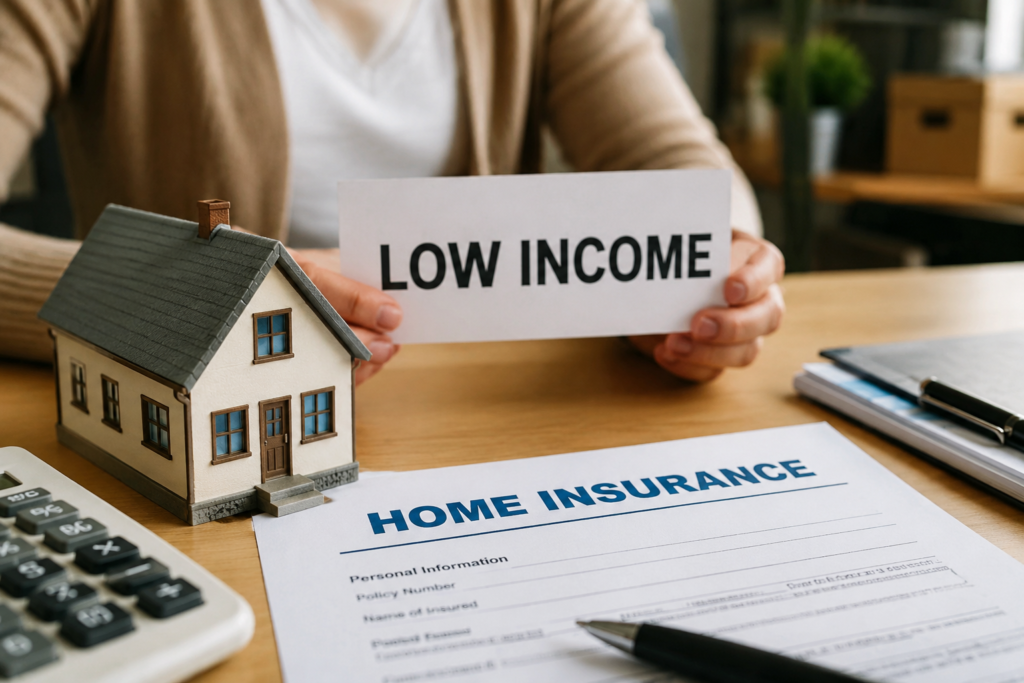
Home Insurance for Low Income:
You Have More Options Than You Think
Protecting your home shouldn’t be a luxury. Here’s every real-world strategy, program, and discount that can get you covered — even on a tight budget.
You’re not alone — and you’re not without options. NittyBrain spent time digging through every real, legitimate path available to low-income homeowners in 2026 so that you don’t have to wade through vague advice that leads nowhere.
This isn’t a list of tips you’ve already googled. This is a clear-eyed, practical breakdown of what actually works — from little-known government programs to specific discounts your current insurer is probably hoping you won’t ask about.
Why Home Insurance Is Hard to Afford — And Getting Harder
Home insurance premiums across the United States have climbed sharply since 2019 — up over 107% nationally according to recent market data. The pace slowed a little in 2025, but the pressure hasn’t eased for most households. Florida homeowners, for example, saw premiums rise roughly 75% between 2021 and 2025 alone.
What’s driving this? Three things above everything else: inflation in construction and labor costs, climate-related disasters hitting more regions more frequently, and insurers pulling back from high-risk areas — which leaves fewer competitors and higher prices for those who remain.
For low-income households, this intersection is brutal. When your income doesn’t grow at the pace your insurance bill does, coverage starts to feel like a choice between protection and necessities. That’s a false choice, and this guide is here to show you why.
One-third of Americans say their homeowners insurance premium went up in the past twelve months — and in disaster-prone states, the situation is significantly worse. The squeeze is real, but so are the paths around it.
— NittyBrain Research, 2026
Does Your Income Directly Affect Your Premium?
Here’s something most people don’t know: your income itself is not a rating factor in homeowners insurance. Insurers don’t legally set your premium based on what you earn. What they do look at, however, are several factors that often correlate with income — and understanding these is the first step to pushing back on a high quote.
What Actually Drives Your Premium
- Credit score: In most states, insurers use a credit-based insurance score to set rates. A 2025 Consumer Federation of America report found the typical homeowner pays nearly $2,000 more per year with a low credit score. Four states — California, Hawaii, Maryland, and Massachusetts — prohibit this entirely.
- Home age and condition: Older homes with dated electrical, plumbing, or roofing systems are rated as higher risk. The older the systems, the higher the quote.
- Location and ZIP code: Proximity to flood zones, wildfire corridors, or high-crime areas all push rates up.
- Claims history: Past claims on your record or your home’s record raise your rate, even if the damage was minor.
- Dwelling coverage amount: The more coverage you carry, the more you pay — but underinsuring your home creates its own risks.
State FAIR Plans: Your Safety Net When No One Will Cover You
If private insurers keep declining your application — whether because of your home’s location, age, or condition — there is a fallback every state in the country is required to provide: the FAIR Plan.
FAIR stands for Fair Access to Insurance Requirements. These are state-managed insurance programs created specifically for homeowners who cannot find coverage in the standard private market. They exist in every state, though they go by different names depending on where you live.
What FAIR Plans Cover
FAIR plans typically provide basic coverage for fire, lightning, windstorm, and vandalism. They generally do not include the broader liability protection, theft coverage, or living expenses coverage that a standard HO-3 homeowners policy provides. Think of them as a floor — not a ceiling.
What FAIR Plans Cost
Here’s the complication: FAIR plans are not automatically cheaper. Because they serve higher-risk properties and do not offer the full discount structure of private insurers, they can cost 25% to 50% more than a comparable private policy. They also typically do not offer bundling discounts or loyalty savings. The California FAIR Plan, for example, raised rates by 29% in October 2025 as reinsurance costs increased.
How to Apply for a FAIR Plan
Contact your state’s department of insurance and ask for your state’s FAIR plan administrator. Some states run them directly; others operate through an assigned risk pool managed by private insurers. A licensed insurance agent in your state can often help you apply and may also be able to supplement a FAIR plan with a separate “difference in conditions” policy that fills coverage gaps.
If you’re on a FAIR plan, don’t stop shopping. The FAIR plan is a stepping stone, not a permanent home. As your home improves (new roof, updated electrical, better credit score), re-apply to private insurers each year. Many homeowners who start on FAIR plans successfully transition to cheaper private coverage within a few years.
Government Programs That Can Help Low-Income Homeowners
There is no single federal program that pays your home insurance premium directly. But there is an ecosystem of programs — federal, state, and local — that can reduce the financial pressures that make insurance feel unaffordable. Understanding the full picture is what separates a homeowner who stays protected from one who quietly goes without.
| Program | Who It Helps | What It Does | Type |
|---|---|---|---|
| HUD Housing Counseling | Any low-income homeowner | Free guidance from HUD-approved counselors on managing housing costs, including insurance options and assistance programs in your area | Federal |
| USDA Section 504 Home Repair | Very low-income rural homeowners | Grants and loans to repair, modernize, or remove safety hazards — reducing the damage risk that inflates your premiums | Federal |
| Weatherization Assistance Program (WAP) | Income-qualifying households | Funded by the Department of Energy to upgrade insulation, heating systems, and energy efficiency — a better-maintained home often attracts lower insurance rates | Federal |
| HUD HOME Investment Partnerships | Low-income owners and renters | Federal block grants administered by states and localities for housing rehabilitation and repairs | Federal/State |
| State Department of Insurance Programs | Varies by state | Many states operate premium assistance programs, market conduct oversight, and consumer advocacy services specifically for low-income policyholders | State |
| Local Housing Authorities | Varies by municipality | Some counties and cities offer emergency home repair funds, forgivable loans, and financial counseling that indirectly stabilize housing costs | Local |
| Nonprofit Housing Organizations | Varies by organization | Organizations like Habitat for Humanity and local community development groups sometimes connect homeowners with subsidized insurance or repair assistance | Nonprofit |
The Repair-Insurance Connection
One angle that gets overlooked: government and nonprofit home repair programs don’t just fix your home — they improve its insurability. A roof replaced through a USDA Section 504 grant, or a heating system upgraded through WAP, directly reduces the risk factors that inflate your insurance premium. Think of these programs as dual-purpose: they protect your home and reduce what you pay to protect it.
Which Insurers Are Cheapest for Low-Income Homeowners in 2026?
Pricing varies enormously by state and individual risk profile, but 2026 rate data gives us a useful national baseline to work from. These figures come from NerdWallet’s analysis of over 270 million rates across more than 100 insurance companies in all 50 states.
| Insurer | Avg. Annual Rate (2026) | Notes |
|---|---|---|
| USAA | ~$1,940/yr | Lowest rates nationally — available to military members, veterans, and their families only |
| State Farm | ~$2,415/yr | Cheapest among large, widely-available insurers; strong nationwide footprint |
| Travelers | ~$2,055/yr | Competitive rates; strong discount portfolio for qualifying homes |
| American Family | ~$4,235/yr | Among the more expensive widely-available insurers — worth comparing carefully |
These are national averages for a $400,000 dwelling with $300,000 liability coverage and a $1,000 deductible — your actual quote will vary. What these numbers illustrate is the range: the difference between the cheapest and most expensive large insurer is over $2,000 per year for the same home and the same coverage. That’s why comparison shopping isn’t optional — it’s essential.
States Where Insurance Is Cheapest
If you have any flexibility in where you live, or are simply curious where your state ranks: Hawaii, Vermont, and Delaware consistently show the lowest homeowners insurance rates nationally. Oklahoma, Nebraska, and Kansas are among the most expensive due to tornado and severe weather exposure. Understanding your state’s risk profile helps explain your premium — and tells you when a quote is unusually high even for your area.
Regional and local insurers sometimes offer more competitive rates than national carriers in specific states. When comparing quotes, always include at least one regional insurer alongside the national names. Your state’s department of insurance website typically has a list of licensed carriers operating in your market.
Why You Should Never Drop Coverage — Even If You Own Your Home Outright
When money is tight and the premium feels like a burden, the idea of dropping home insurance can creep in — especially if you’ve paid off your mortgage and no lender is requiring you to carry it. This is one of the most financially dangerous decisions a homeowner can make.
Here’s the reality: a single house fire, a burst pipe that floods two floors, a guest who slips on your front steps and sues — any one of these events can cost tens of thousands of dollars. Without insurance, that cost comes entirely from your pocket. For low-income homeowners, that’s often the cost of the home itself.
Instead of dropping coverage, use every strategy in this guide to reduce what you pay to a manageable level. A policy with a higher deductible and carefully chosen coverage limits is far better than no policy at all.
Frequently Asked Questions
Yes. Your income level does not directly determine whether you can get homeowners insurance. Low-income homeowners have several real paths available: shopping and comparing multiple quotes, applying for state FAIR plan coverage if private insurers decline, bundling with auto insurance, raising the deductible, and pursuing state or local assistance programs. The key is persistence and knowing which levers to pull.
A FAIR (Fair Access to Insurance Requirements) plan is a state-backed program that provides basic homeowners insurance to people who cannot secure coverage from private insurers. It exists in every state and acts as an insurer of last resort. Coverage is generally more limited than a standard private policy and can be more expensive, but it does keep your home protected. To apply, contact your state’s department of insurance, ask for your state’s FAIR plan administrator, or work with a licensed local insurance agent who can guide you through the process.
There’s no federal program that directly covers your insurance premium. However, programs like USDA Section 504, HUD HOME Investment Partnerships, and the Weatherization Assistance Program help low-income homeowners repair and maintain their homes — reducing the risk factors that drive premiums up. HUD-approved housing counselors can also help you find local programs and negotiate more affordable coverage options. Calling 211 or visiting your state’s department of insurance website is a good starting point.
The national average is roughly $208 per month (about $2,490 per year) for $400,000 of dwelling coverage, based on NerdWallet’s 2026 analysis of over 270 million rate samples. However, rates vary dramatically by state. Hawaii averages as low as $376 per year while Oklahoma can exceed $3,500. Low-income homeowners who comparison-shop, bundle policies, and use available discounts can often find coverage significantly below the national average.
Common discounts you should always ask about include: bundling home and auto policies (up to 25% off), installing smoke detectors, burglar alarms, or deadbolt locks, maintaining a claim-free history, paying your annual premium in full upfront rather than monthly, enrolling in paperless billing, and professional or affinity discounts for teachers, military personnel, firefighters, and others. Many homeowners never ask about discounts — and never receive ones they would qualify for. One phone call to your insurer can make a real difference.
No — and this is important. Going without home insurance leaves you completely exposed to fire, storms, theft, and liability claims that can cost tens of thousands of dollars. Even if you own your home outright and no lender requires you to carry insurance, the financial risk of being uninsured far outweighs the cost of coverage. Instead, focus on reducing what you pay using strategies like raising your deductible, shopping multiple quotes, and bundling policies. A policy with higher out-of-pocket costs is always better than no policy at all.
In most states, yes — significantly. A 2025 Consumer Federation of America report found that typical homeowners pay nearly $2,000 more per year just for having a low credit score, compared to someone with an excellent score insuring the same home. However, four states — California, Hawaii, Maryland, and Massachusetts — legally prohibit insurers from using credit history to set premiums. If you live in one of those states, your credit score has no impact on your rate. In all other states, improving your credit score over time is one of the most powerful long-term strategies for reducing your insurance premium.
Ready to Find a Better Rate?
The strategies in this guide work best when you act on them — starting with comparing multiple quotes. It takes 15 minutes and can save hundreds per year.