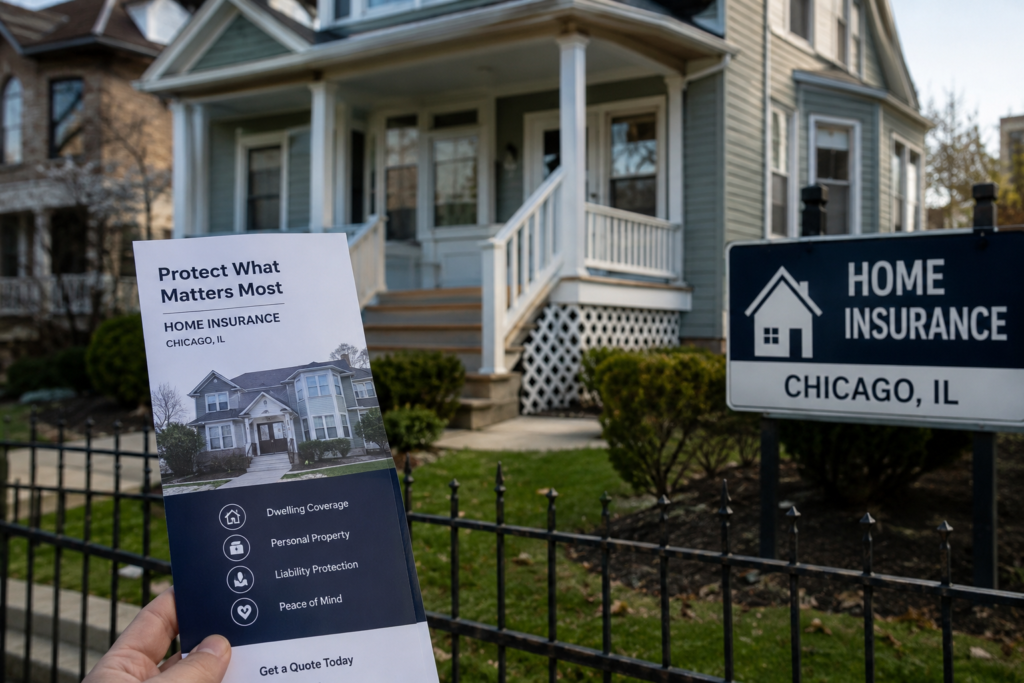
Home Insurance for a building in Chicago
Home Insurance for a Building in Chicago: The Complete 2026 Owner’s Guide
What it actually costs to insure a house, greystone, or multi-unit building in Chicago right now — and the coverage gaps that catch owners off guard.
Quick answer: Home insurance for a building in Chicago runs roughly $2,800 to $3,450 a year on average for a standard single-family policy with $300,000 in dwelling coverage, though your actual number depends heavily on the building’s age, type, and whether you live in it or rent it out.
If you own a two-flat, three-flat, or greystone, expect a different policy type entirely — and a different set of numbers. We break both down below.
What’s in this guide
- What “home insurance for a building” actually covers
- What it costs in Chicago right now
- Why Chicago premiums run above the national average
- Insurance by Chicago building type
- The coverage checklist most Chicago owners are missing
- Where to find the better rates
- Seven ways to bring your premium down
- Frequently asked questions
What “home insurance for a building” actually covers
Before you request a single quote, it helps to know which policy you’re actually shopping for, because Chicago’s housing stock doesn’t fit neatly into one box the way suburban subdivisions do. “Home insurance for a building” can mean three different things depending on how the property is used:
- Homeowners insurance (HO-3) — you own the building and live in it as your primary residence, whether that’s a bungalow, a single-family frame house, or a greystone you occupy alone.
- Landlord or dwelling-fire insurance (DP-3) — you own the building but don’t live in any part of it. This is the policy type for a pure rental two-flat, three-flat, or small apartment building.
- Condo insurance (HO-6) — you own a unit inside a larger building, and the building’s own master policy covers the shared structure while your HO-6 covers your unit’s interior, belongings, and liability.
Getting this distinction right matters more than it sounds. Insurers price these three policy types very differently, and buying the wrong one can leave you underinsured exactly when you need coverage most — say, insuring your rental two-flat under a standard homeowners policy that technically excludes tenant-occupied risk.
What it costs in Chicago right now
Chicago has consistently priced above the Illinois state average for years, and that gap has held steady into 2026. Here’s how the numbers currently stack up for a standard single-family home with $300,000 in dwelling coverage and a $1,000 deductible.
Average annual premium in Chicago proper
Illinois statewide average — Chicago runs about 11% higher
Cheapest available rate, typically through Allstate
Example rebuild cost for a 3,700 sq ft three-unit building near downtown
Two things move that number more than anything else: how much dwelling coverage you carry, and where in the city the building sits. Naperville, Aurora, and Joliet all price 14 to 16 percent below Chicago proper, mostly because their housing stock is newer and less dense. Inside city limits, older, denser neighborhoods with more masonry construction tend to sit at the higher end of that range.
Why Chicago premiums run above the national average
None of this is random. Insurers price Chicago the way they do because of a specific, repeatable set of local risk factors:
Weather that hits hard and hits often
Illinois sits inside the Midwest’s severe weather corridor. Tornado and hail activity in spring and summer, combined with brutal winters that freeze pipes and stress roofs, gives insurers more frequent claims to price into every policy — not catastrophic hurricane-style losses, but a steady drumbeat of smaller ones that add up.
Age of the housing stock
A meaningful share of Chicago’s residential buildings predate 1940. Illinois-wide data shows a roughly 79 percent premium markup between newer and older homes — a gap of well over a thousand dollars a year for identical coverage, driven by outdated wiring, older plumbing, and roofs that weren’t built to current code.
Density and property crime
Chicago’s population density pushes both fire spread risk and property crime exposure higher than in surrounding suburbs, and insurers factor local crime data directly into their underwriting.
Water, not wind, is the quiet threat
Lake Michigan and the Chicago River sit close to a huge share of the city’s housing stock, and the sewer system wasn’t built for the rainfall volumes it now regularly sees. Standard policies exclude flood damage entirely, which means a lot of Chicago owners are carrying a gap they don’t know about until the basement floods.
Insurance by Chicago building type
This is where Chicago diverges hardest from generic homeowners-insurance advice, because so much of the city’s housing stock isn’t a standalone single-family home. Here’s what changes by building type.
Greystones, two-flats, and three-flats
These century-old, stone-fronted multi-unit buildings are a defining feature of neighborhoods like Logan Square, Humboldt Park, and parts of the South Side. If you live in one unit and rent the rest, most carriers will still write it as an owner-occupied policy, but expect underwriting questions about knob-and-tube wiring, galvanized or lead plumbing, and the condition of the masonry and tuckpointing. If you don’t live in the building at all, you’ll need a landlord policy, and premiums for those typically run 15 to 25 percent above a comparable owner-occupied policy because of the added tenant and liability exposure.
Bungalows and single-family frame houses
The classic Chicago bungalow — brick, one and a half stories, built mostly between the 1910s and 1940s — generally qualifies for standard HO-3 coverage, but age-related underwriting still applies. Insurers will often ask about roof age, electrical panel type, and whether the home has been rewired or replumbed, since those upgrades can meaningfully lower your rate.
Condos and co-ops
If you own a unit rather than a full building, your HO-6 policy fills the gap between what the building’s master policy covers and what’s actually yours — your unit’s interior finishes, your belongings, and your personal liability. Always ask the condo association for a copy of the master policy’s coverage limits before assuming you’re protected; gaps here are common and expensive to discover after a loss.
Small apartment and rental buildings
Four units and up typically moves you out of standard landlord insurance and into a commercial apartment building policy, which usually bundles building coverage, liability for tenant and guest injuries, and sometimes loss-of-rental-income coverage if a covered loss makes units uninhabitable.
The Chicago-specific coverage most owners skip
Chicago Building Ordinance or Law coverage pays the added cost of rebuilding to current code after a covered loss — not just restoring what was there. For a century-old greystone or two-flat, code upgrades to electrical, plumbing, and fire egress during a rebuild can run into the tens of thousands of dollars, and a standard policy simply won’t reimburse that gap unless this endorsement is added.
The coverage checklist most Chicago owners are missing
Beyond the basics of dwelling and liability coverage, these are the add-ons that matter most for a Chicago building specifically:
- Sewer backup and sump pump overflow coverage — not included by default, and one of the most common claim types in the city during heavy rain.
- Separate flood insurance — required if you’re near Lake Michigan, the river, or in a designated flood zone, since standard policies exclude it entirely.
- Ordinance or law coverage — essential for any building older than roughly 50 years, given how often code changes since original construction.
- Replacement cost dwelling coverage — set to what it actually costs to rebuild at current Chicago construction prices, not the home’s market value or tax-assessed value.
- Loss of rental income (for landlords) — typically covers up to 12 months of fair rental value if a covered loss makes a unit unrentable during repairs.
- Other structures coverage — for detached garages, coach houses, and fences common on Chicago lots, usually set around 10 percent of your dwelling limit by default.
- Umbrella liability — worth adding if you rent out any part of the building, given the higher liability exposure that comes with tenants.
Where to find the better rates
Pricing on identical Chicago properties can vary enormously between carriers — a difference of hundreds of dollars a month is common for the same coverage, because every insurer weighs local risk factors like roof age, tree coverage, and proximity to fire hydrants differently. Based on current market data, here’s a general sense of where the value tends to land:
| Insurer | Where it tends to stand out | Best fit |
|---|---|---|
| Allstate | Consistently the cheapest average rates in Chicago | Budget-conscious single-family owners |
| Auto-Owners | Strongest pricing for owners with excellent credit | Owners with a high credit-based insurance score |
| USAA | Competitive rates and strong service ratings | Military-affiliated households (membership required) |
| Chubb | High-limit coverage for fine art, jewelry, and high-value finishes | Gold Coast and Lincoln Park owners of high-value homes |
| State Farm / Nationwide | Broad availability and easy bundling with auto policies | Owners who want one carrier for home and auto |
Whichever insurer you lean toward, get at least three quotes before committing — identical Chicago properties routinely receive very different offers depending on how each carrier’s underwriting model reads your specific block.
Seven ways to bring your premium down
- Compare at least three quotes every renewal. Loyalty rarely pays in this market; rates on the same property shift meaningfully year to year between carriers.
- Document upgrades to wiring, plumbing, and the roof. Photos, receipts, and inspection reports can move you into a lower risk tier with insurers who factor in modernization.
- Bundle home and auto. Most major carriers discount both policies by 10 to 20 percent when bundled.
- Raise your deductible if you have the cash reserve to cover it. Moving from a $500 to a $1,000 deductible is one of the fastest ways to cut your premium.
- Improve your credit score before you shop. Illinois carriers weight credit-based insurance scores heavily — the gap between excellent and poor credit can run into the thousands annually.
- Install monitored smoke and security systems. Most insurers offer a direct discount for both.
- Limit vacancy on rental units. An empty unit is a magnet for frozen pipes and break-ins, and some insurers price vacancy risk directly into landlord policies.
Ready to compare real quotes on your building?
Get your details together — building type, square footage, year built, and whether you occupy it — before you request quotes. It’s the fastest way to get accurate numbers instead of rough estimates.
Frequently asked questions
Is home insurance legally required for a building in Chicago?
No. Illinois does not require homeowners insurance by law. But any mortgage lender will require it for as long as you carry a loan on the property, and going without it leaves you personally responsible for the full cost of rebuilding after a fire, storm, or other covered loss.
Does regular home insurance cover flood damage in Chicago?
No. Standard homeowners and dwelling policies exclude flood damage, including water that backs up through sewers during heavy rain. Chicago owners typically need a separate flood policy through the NFIP or a private flood insurer, plus a sewer backup endorsement on their main policy.
Do I need a different policy for a two-flat or three-flat building?
If you live in one unit and rent out the others, most insurers will write it as an owner-occupied dwelling policy. If you don’t live on-site at all, you’ll typically need a landlord or dwelling-fire policy, which usually costs 15 to 25 percent more than a standard homeowners policy because of the added liability and tenant exposure.
What is ordinance or law coverage and do I need it for an older Chicago building?
Ordinance or law coverage pays the extra cost of rebuilding to meet current building codes after a covered loss, rather than just restoring the building as it was. It matters a lot for pre-1940s Chicago buildings, since code upgrades to wiring, plumbing, or fire egress can add tens of thousands of dollars to a rebuild that a standard policy won’t reimburse.
This guide is for general informational purposes and reflects publicly available market data as of July 2026. Insurance pricing varies by individual property, coverage selections, and insurer underwriting. Always confirm current rates and policy terms directly with a licensed insurance agent or carrier before purchasing coverage.