Car Insurance Online: Everything You Actually Need to Know in 2026
From getting your first quote in under ten minutes to cutting your premium by hundreds of dollars a year — this is the guide NittyBrain wish existed when we started shopping.
Avg. monthly full-coverage premium (2026)
Average time to buy online
Saved annually by shoppers comparing 3–5 quotes
Max telematics discount available to safe drivers
Why Buy Car Insurance Online?
There was a time when buying car insurance meant clearing your afternoon, sitting in an agent’s office, and nodding along while someone turned their screen toward you. That era is largely over. Today, the most competitive car insurance rates in the country are found online — not in a local branch — and the entire process can happen between two cups of coffee.
But the real advantage isn’t just speed. It’s transparency. When you shop for car insurance online, you see pricing side by side. You control the variables. You can raise your deductible by $250 and watch the premium drop in real time. You can add roadside assistance and see exactly what that costs per month. No sales pressure, no upsell scripts.
For most drivers, the online path leads to better coverage at a lower price — because it forces insurers to compete on a level playing field. Here’s what the data actually shows:
- Over half of drivers who compare three or more quotes online save at least $500 annually, according to industry research.
- Full-coverage premiums vary by more than $100 per month between the cheapest and most expensive national carriers — for the same driver profile.
- Most major insurers activate coverage the same day you pay online, meaning you don’t have to go uninsured for even a single day during a switch.
NittyBrain’s Take: The single best financial move most drivers can make in 2026 is to spend 20 minutes comparing car insurance quotes online. The savings potential is disproportionate to the effort involved.
What You Need Before You Start
Gathering this information before you open any insurer’s website saves you from half-completed forms and inaccurate quotes. Have the following ready:
- Your driver’s licence number (and the same for any additional drivers on the policy)
- Your vehicle identification number (VIN) — found on your dashboard, door frame, or registration
- The make, model, year, and trim of every vehicle you’re insuring
- Your home address and ZIP code — insurers rate down to the neighbourhood level
- Your estimated annual mileage (check your last odometer reading if unsure)
- Your current insurer and policy expiry date — useful for timing a clean switch
- Details of any accidents, violations, or claims in the past 3–5 years
- Your Social Security number (optional at quote stage but insurers use it for a soft credit check that affects your final rate)
Don’t skip the VIN. A VIN unlocks your vehicle’s safety rating, anti-theft features, and repair cost history — all of which can lower your quoted premium. Without it, some insurers quote a conservative (higher) rate and adjust later.
How to Buy Car Insurance Online: Step by Step
The process looks slightly different on every platform, but the logic is always the same. Follow these six steps and you’ll arrive at an active policy without a single phone call.
Decide How Much Coverage You Actually Need
Every state mandates a minimum level of liability coverage, but minimums are often woefully inadequate. If you caused a serious accident, a $25,000 bodily injury limit wouldn’t cover a single night in an ICU. Most financial advisers recommend at least $100,000/$300,000 for bodily injury. If you have a car loan or lease, your lender almost certainly requires full coverage (comprehensive + collision on top of liability). Start with what you legally need, then honestly assess what you can afford to lose.
Collect Quotes from Multiple Sources
Don’t stop at one website. Use the insurer’s direct site, an independent comparison tool, and an independent agent if you have one. Each insurer weighs your driving history, credit profile, and ZIP code differently — which is exactly why two drivers with identical profiles can receive wildly different quotes. Aim for at least three to five quotes before deciding.
Compare Apples to Apples
A quote that looks $40 cheaper per month may carry a $2,000 higher deductible or entirely different liability limits. Always compare quotes at the same coverage level, the same deductibles, and with the same list of add-ons (or without). The cheapest number isn’t always the best value — especially if it leaves you exposed in a serious claim.
Apply Available Discounts
Most insurers present discount options during the quote flow itself. Good driver discounts, multi-car discounts, bundling with your homeowners or renters policy, paperless billing, and paying in full annually are the most common. Don’t assume they’re automatically applied — check each category before finalising the quote.
Review, Sign, and Pay
Once you’ve chosen a policy, you’ll review the declarations page — a summary of every coverage, limit, and premium. Read it. Confirm that every discount you selected appears. Choose your payment method (most carriers accept credit cards, debit cards, and bank transfers; some offer a small discount for paying annually in full). Once payment is processed, your coverage is live.
Download Proof of Insurance Immediately
Your new insurer will email you a declarations page and digital insurance cards within minutes. Download the app if the insurer has one — digital proof is accepted in every US state as a substitute for a physical card. Then — and only after your new coverage is confirmed active — cancel your old policy to avoid a gap.
Understanding the Coverage Types You’ll See Online
Every online quote form will ask what coverage you want. Here’s what each category actually does — in plain English.
Liability Coverage
This is the only coverage required in virtually every US state. It pays for other people’s medical bills and property damage when an accident is your fault. It does not cover your own vehicle or your own injuries. Liability is expressed as three numbers — for example, 100/300/50 means $100,000 per injured person, $300,000 total per accident, and $50,000 for property damage.
Collision Coverage
Collision pays to repair or replace your own vehicle after a crash — whether you hit another car, a tree, or a guardrail. It applies regardless of fault. You choose a deductible (commonly $500 or $1,000) and pay that amount out of pocket; the insurer covers the rest up to the car’s actual cash value.
Comprehensive Coverage
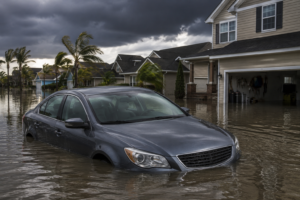
Comprehensive handles damage to your vehicle that isn’t a collision — think theft, vandalism, hail, flooding, fire, or a deer deciding your bonnet looks like a landing pad. If you live in a state with severe weather risk (Florida hurricanes, Texas hail) or high vehicle theft rates, this coverage earns its price quickly.
Uninsured / Underinsured Motorist (UM/UIM)
Roughly 1 in 7 drivers on American roads has no insurance at all. UM/UIM coverage protects you when one of them hits you and can’t cover your medical bills or vehicle damage. Some states mandate it; NittyBrain recommends it regardless of where you live.
Personal Injury Protection (PIP) & Medical Payments (MedPay)
These pay your own medical expenses after an accident regardless of fault — useful in states where health insurance and liability coverage leave gaps. PIP is required in “no-fault” states like Florida, Michigan, and New York.
Quick Rule of Thumb: If your car is worth less than $4,000, dropping collision and comprehensive (and just keeping liability) may save you more than a possible payout. If it’s worth more — or if you couldn’t replace it without a loan — keep full coverage.
Best Car Insurance Companies to Buy Online in 2026
NittyBrain reviewed ranking data from NerdWallet, U.S. News, Money, and Insure.com alongside J.D. Power satisfaction scores and NAIC complaint ratios to identify which carriers consistently deliver online. Here’s the honest picture.
| Company | Best For | Online Experience | NittyBrain Rating |
|---|---|---|---|
| Amica Top Pick | Overall quality + claims satisfaction | Excellent — digital quote, app, same-day coverage | ★★★★★ |
| GEICO | Cheapest rates + discount range | Excellent — one of the fastest quote flows available | ★★★★☆ |
| Travelers | Best budget pick among large carriers | Very good — clear coverage explanations online | ★★★★☆ |
| Progressive | Quote customisation + rideshare coverage | Excellent — Name Your Price tool is genuinely useful | ★★★★☆ |
| Nationwide | Balanced coverage options | Good — SmartRide telematics easy to enrol online | ★★★★☆ |
| State Farm | Young drivers + local agent support | Good — Drive Safe & Save app is straightforward | ★★★★☆ |
| USAA | Military families (lowest complaint ratios) | Excellent — members only but flawless digital experience | ★★★★★ |
| Erie Insurance | Claims handling (A− CRASH Network grade) | Moderate — some features require an agent | ★★★★☆ |
A quick word on Acuity: NerdWallet flagged it as the insurer with the fewest customer complaints relative to its size in 2026. If you’re in a state where it operates and want the absolute minimum likelihood of a claims dispute, it’s worth a quote even if the brand is less well known.
What Does Car Insurance Actually Cost? (2026 Rates)
The national average for full-coverage car insurance sits at roughly $208 per month ($2,496 per year) in 2026. But that single number hides an enormous range. Where you live, what you drive, and who else is on your policy can push your premium far above or below that figure.
Most Expensive States for Car Insurance
$4,000+/yr
High repair costs, dense urban claims
~$3,950/yr
Extreme weather + litigation frequency
~$3,874/yr
Hurricanes + 20% uninsured driver rate
$3,600+/yr
Rapid growth + high vehicle theft
Most Affordable States for Car Insurance
$128/mo
Rural roads, low population density
~$685/yr
Fewest metro areas, low accident frequency
~$773/yr
Only 5.7% uninsured drivers (vs. 14% national avg)
Well below avg.
Sparse population, low crime rates
Six Factors That Move Your Rate the Most
Your state sets the floor, but these six variables determine exactly where your personal premium lands:
- Location down to your ZIP code. Moving from one neighbourhood to another in the same city can shift your premium significantly.
- Your driving record. A speeding ticket, at-fault accident, or DUI each trigger rate increases — sometimes lasting three to five years.
- Your age. Teen drivers pay roughly 73% more than average, according to Insurify data. Drivers in their 60s pay about 27% less.
- Your credit-based insurance score. In states that allow it, drivers with excellent credit pay about 17% less than average. (California, Michigan, and Massachusetts ban credit scoring for insurance.)
- Your vehicle. Newer, pricier, and higher-theft vehicles cost more to insure. Electric vehicles — Teslas in particular — carry above-average premiums due to repair costs.
- Your coverage level and deductibles. Every $100 you raise your deductible typically lowers your premium; every additional coverage layer raises it.
How to Save Money on Car Insurance Online
Most drivers leave hundreds of dollars on the table every year — not because they can’t afford better rates, but because they don’t know where to look. NittyBrain has mapped out the highest-impact savings levers available in 2026.
Discounts Worth Actively Chasing
Bundle home + auto (10–25% off)
Good driver discount
Defensive driving course
Low-mileage discount
Anti-theft device installed
Paperless billing
Pay in full annually
Good student discount
New car discount
Loyalty/long-term customer
Telematics safe-driver program
GEICO and Farmers each offer up to 23 different discount categories — more than most national competitors. But even a smaller insurer might stack five or six discounts that bring your premium below what any single “cheapest company” can offer.
The Bundling Play
Combining your auto insurance with a homeowners or renters policy through the same carrier is one of the cleanest savings moves available. Discounts range from 10% to 25% on both policies. Amica, State Farm, and GEICO all support bundling in their online quote flows — you can model the savings before you commit.
Raise Your Deductible (Strategically)
Raising your collision or comprehensive deductible from $500 to $1,000 typically lowers your premium by 10% to 15%. The trade-off is clear: you absorb more cost in a minor claim. This works well if you have a solid emergency fund and your car isn’t a leased vehicle with deductible limits specified by the lender.
Shop at Every Renewal
Your insurer is almost certainly not giving you their most competitive rate at renewal. Premiums are recalculated based on current market conditions, local claims trends, and — silently — whether you’ve shown any inclination to shop around. Setting a calendar reminder to compare quotes every 12 months is one of those simple financial habits that pays reliably.
NittyBrain Shortcut: Compare rates at the same time every year — ideally 30 days before your renewal date. That gives you enough time to switch cleanly without a gap in coverage and avoids the last-minute pressure that leads to lazy decisions.
Should You Try Telematics? (The Honest Answer)
Telematics — also called usage-based or pay-how-you-drive insurance — tracks your actual driving behaviour through a smartphone app or a plug-in device, then adjusts your premium based on what it finds. In 2026, it’s one of the most talked-about ways to lower car insurance costs online. Here’s what the data says.
How the Savings Actually Work
Safe drivers can realistically save between 10% and 40% on their premiums through telematics programs. Allstate’s Drivewise and Nationwide’s SmartRide advertise the highest maximum discounts (up to 40%). State Farm’s Drive Safe & Save is the most widely adopted program in the country. The behaviour these apps monitor typically includes hard braking, rapid acceleration, late-night driving (especially 11 pm to 4 am), and distracted phone use.
| Program | Insurer | Avg. Saving | Can It Raise Rates? |
|---|---|---|---|
| Drive Safe & Save | State Farm | Up to 30% | No (discount only) |
| SmartRide | Nationwide | Up to 40% | No (discount only) |
| Drivewise | Allstate | Up to 40% | Yes |
| Snapshot | Progressive | Avg. $322/yr for savers | Yes (~20% of users) |
| DriveEasy | GEICO | Varies | Yes |
The Catch Nobody Talks About
A Consumer Federation of America study found that some insurers continue rating based on non-driving factors — like credit score and ZIP code — even for drivers enrolled in telematics programs. Maryland’s insurance department confirmed this pattern: most enrolled drivers in the state did not actually see premium reductions. Meanwhile, programs like Progressive’s Snapshot raised rates for roughly 1 in 5 participants.
The safe strategy: If you’re a confident safe driver, enrol only in discount-only programs (State Farm, Nationwide) to eliminate the downside risk entirely. If you commute in heavy stop-and-go traffic or regularly drive late at night, weigh the risk carefully before enrolling in programs that can penalise as well as reward.
Mistakes to Avoid When Shopping for Car Insurance Online
The online process is fast, but fast also means easy to rush. These are the mistakes NittyBrain sees drivers make most often — and how to sidestep each one.
1. Picking the Lowest Number Without Reading What It Covers
A policy with a $500 lower annual premium but a $2,000 higher deductible is only a bargain if you never file a claim. Compare total financial exposure, not just the monthly premium line.
2. Forgetting to Disclose All Drivers in the Household
Omitting a teenager or a partner from your application to save money is considered material misrepresentation. If that undisclosed driver is involved in an accident, your insurer can deny the claim entirely. Always list every licensed driver who might use the vehicle.
3. Letting Coverage Lapse Between Policies
Even a single day without insurance creates a coverage gap on your record. Future insurers flag this and charge higher rates. Confirm your new policy’s start date is the same as or earlier than your old policy’s end date.
4. Not Checking Your State’s Minimum Requirements
New Jersey raised its minimum uninsured and underinsured motorist limits in 2026 — contributing directly to a $383 average rate increase for state drivers. Minimums change. Verify current requirements in your state before assuming last year’s policy still complies.
5. Buying Only Minimum Liability
State minimums are legal floors, not recommended coverage levels. A serious accident can generate liability that exceeds minimum limits within hours. The marginal cost of doubling your liability limits is usually small; the cost of being underinsured in a major claim is enormous.
6. Using a Public Wi-Fi Network to Complete Payment
This sounds obvious, but it’s worth saying: finalise your application and payment on a private, secured network. Car insurance applications contain enough personal data — VIN, licence number, Social Security number — to cause real harm if intercepted.
Frequently Asked Questions
Yes. Most major insurers — including GEICO, Progressive, Travelers, and Nationwide — let you get a quote, customise your coverage, and activate your policy 100% online, without speaking to an agent. Coverage can start the same day you pay.
Most online applications take 10 to 20 minutes. If you have your driver’s licence, VIN, and current insurance details ready beforehand, you can cut that down considerably.
Full-coverage car insurance averages roughly $208 per month ($2,496 per year) nationally in 2026. Minimum-coverage policies start around $49 per month. Rates vary significantly by state, age, driving history, and vehicle.
GEICO consistently ranks among the cheapest national insurers in 2026 for drivers with clean records. Travelers leads for affordability among large carriers. The cheapest option is always personal to your profile — which is exactly why comparing multiple quotes is so important.
No. Insurers run a soft credit check — not a hard inquiry — when calculating your rate. Soft checks are invisible to other lenders and do not affect your credit score.
Yes, on official insurer websites or reputable comparison platforms. Always check for HTTPS in the URL and verify the company holds a valid licence in your state through your state’s Department of Insurance website before entering personal or payment details.
You’ll need your full name and date of birth, driver’s licence number, vehicle VIN, make, model, and year, your home address and ZIP code, estimated annual mileage, and details of any recent accidents or violations. Having your current policy declarations page handy speeds things up considerably.
Yes, for safe drivers. Programs like State Farm’s Drive Safe & Save and Nationwide’s SmartRide offer discounts of up to 40% and cannot raise your rate for poor scores. Programs like Progressive’s Snapshot can raise rates for around 1 in 5 users, so choose your program carefully based on your driving habits.
The Bottom Line: Don’t Overpay for a Policy You Haven’t Compared
Car insurance is one of those mandatory costs that most of us overpay for simply because we set it up once and never revisited it. The online market in 2026 has made comparison more transparent, faster, and genuinely competitive — but only for drivers who use it.
NittyBrain’s honest advice: spend 20 minutes this week comparing quotes from at least three carriers at identical coverage levels. Check your discount eligibility. If you’re a safe driver, explore a discount-only telematics program. And set a reminder to do it again in 12 months.
The insurer keeping your current policy is counting on inertia. Don’t give it to them.