7 Home insurance advise you need to know

Most people buy home insurance the same way they buy a lock for their door: quickly, with a vague sense of protection, and without thinking too deeply about how it actually works.
The problem is, when something goes wrong—a fire, a flood, a break-in—that vague sense of security gets tested.
And in that moment, the difference between “having insurance” and having the right insurance becomes painfully clear.
Good home insurance advice isn’t about selling policies or repeating generic tips. It’s about helping you make decisions that will still make sense years from now, when you actually need the coverage.
Because the truth is simple: insurance only proves its value on a bad day.
Let’s break this down in a practical, honest way, including a real-life scenario that shows how small decisions can have big consequences.
What Home Insurance Is Really Meant to Do
At its core, home insurance is not about covering everything—it’s about protecting you from financial shocks you cannot comfortably absorb on your own.
If a minor repair costs ₦100,000, most homeowners can manage that. But if a fire causes ₦5,000,000 in damage, that’s a different story.Insurance exists for the second situation.
The mistake many people make is expecting insurance to handle both. That misunderstanding leads to poor choices—either over-relying on insurance for small issues or under-preparing for major risks.
The Foundation: Know What You’re Actually Insuring
Your home insurance policy typically covers three main areas:
i. The structure of your home (walls, roof, built-in systems)
ii. Your personal belongings (furniture, electronics, valuables)
iii. Liability protection (if someone is injured on your property)
Sounds straightforward—but the details matter.
Not all policies cover the same risks. Some exclude flooding. Others limit payouts for certain items. Some require specific conditions to be met before a claim is approved.
The most important advice here: don’t assume—verify.
Real-Life Scenario: When “I Thought I Was Covered” Wasn’t EnoughLet’s look at a realistic situation.
Ngozi, a homeowner in Port Harcourt, had been paying for home insurance for years. She wasn’t particularly interested in the details—she just wanted peace of mind.
Then heavy rainfall hit her area, and her home experienced serious water damage. The ground floor was affected, furniture was ruined, and part of the wall needed repairs.
Confident that her insurance would take care of it, she filed a claim.
The response shocked her.
The claim was denied.
The reason? Her policy covered internal water damage like burst pipes, but not flooding caused by external water sources.
Ngozi was frustrated. She had insurance, she had paid regularly, and yet she was left to cover the cost herself.
But when she revisited her policy, the clause was there—clear but overlooked.
The Lesson from Ngozi’s ExperienceNgozi didn’t make a careless mistake. She made a common one: assuming coverage instead of understanding it.
That’s the difference between having insurance and having effective insurance.
After that experience, she took a different approach:
i. She reviewed her policy line by line
ii. She added flood coverage
iii. She documented her home and valuables
iv. She asked questions before renewing
The next time she faced a similar situation, the outcome was very different.
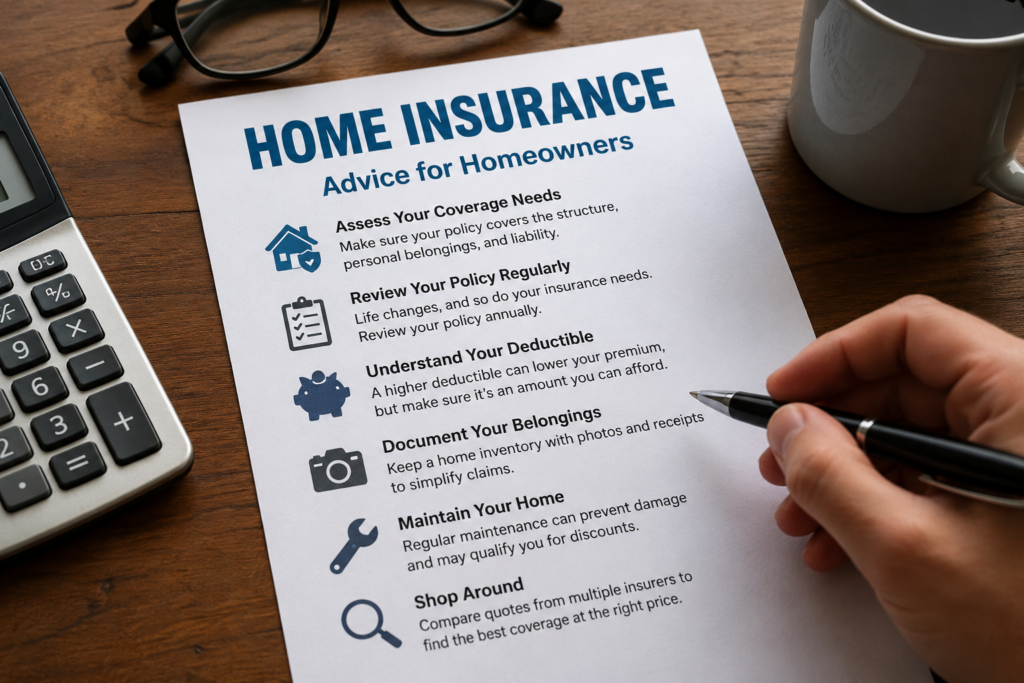
7 Practical Home Insurance Advice That Actually Matters
Let’s move beyond theory and focus on what you should do.
1. Choose Coverage Based on Risk, Not Price
It’s tempting to go for the cheapest policy. But a low premium often comes with limited coverage.
Instead, think about your actual risks:
i. Do you live in a flood-prone area?
ii. Is your home exposed to storms or theft?
iii. Do you own high-value items?
iv. Your policy should reflect your reality, not just your budget.
2. Understand Your Deductible
Your deductible is what you pay out of pocket before insurance steps in.
A higher deductible usually means lower premiums—but also more responsibility when something goes wrong.
The key is balance. Choose a deductible you can comfortably afford without stress.
3. Document Everything Before You Need It
One of the smartest things you can do is create a record of your home and belongings.
Take photos or videos of:
i. Each room
ii. Valuable items
iii. Receipts or proof of purchase
This makes claims faster and more accurate. Without documentation, you’re relying on memory—and that’s risky.
4. Don’t Wait for Damage to Fix Problems
Insurance is not a substitute for maintenance.
If your roof is weak, your plumbing is outdated, or your wiring is faulty, those issues can lead to bigger problems—and possibly denied claims.
Regular maintenance not only protects your home but also strengthens your position if you ever need to file a claim.
5. Think Before You File a Claim
Not every situation requires a claim.
Small repairs might cost less than your deductible. And frequent claims can increase your premium or affect your policy status.
Ask yourself:
i. Is the damage significant?
ii. Is it clearly covered?
iii. Will claiming benefit me in the long run?Sometimes, handling a minor issue yourself is the smarter move.
6. Read Your Policy Like It Matters—Because It Does
Most people ignore the fine print until something goes wrong.
Don’t wait. Focus on:
i. What’s covered
ii. What’s excluded
iii. Limits on certain items
iv. Conditions for claims
If something is unclear, ask your insurer. It’s better to ask now than regret later.
7. Review Your Policy Regularly
Your life changes. Your insurance should too.
If you renovate your home, buy new valuables, or move to a different area, your coverage may need updating.
A policy that made sense three years ago may not be adequate today.
Another Real-Life Insight: Small Change, Big Impact
After her initial claim denial, Ngozi made one simple but powerful change—she started asking questions.
At her next renewal, she didn’t just accept the policy. She asked:
“What exactly is not covered?”, “What situations would lead to a denied claim?”, “What add-ons should I consider based on my location?”.
That conversation led her to upgrade her policy slightly—at a modest increase in cost.
A year later, when another heavy rainfall caused damage, her new coverage kicked in. This time, her claim was approved.
The difference wasn’t luck. It was awareness.
Common Mistakes Homeowners Make
Even well-meaning homeowners fall into traps.
i. Buying insurance and forgetting about it
ii. Assuming all water damage is covered
iii. Underestimating the value of their belongings
iv. Filing too many small claims
v. Not keeping records
Avoiding these mistakes puts you ahead of most people.
The Bigger Picture
Home insurance is not just a financial product—it’s a strategy.
It’s about preparing for uncertainty in a way that protects your long-term stability.
When done right, it gives you confidence. When done poorly, it creates false security.
Final Thoughts
Good home insurance advice isn’t complicated, but it does require intention.
Understand what you’re buying. Match your coverage to your real risks. Keep records. Maintain your home. Ask questions.
And most importantly, don’t treat insurance like a formality.
Because when something goes wrong—and at some point, something will—you don’t want to be figuring things out under pressure.
You want to already know that you’re covered, prepared, and in control.
That’s the real value of home insurance—not just the policy itself, but the confidence that comes from getting it right.