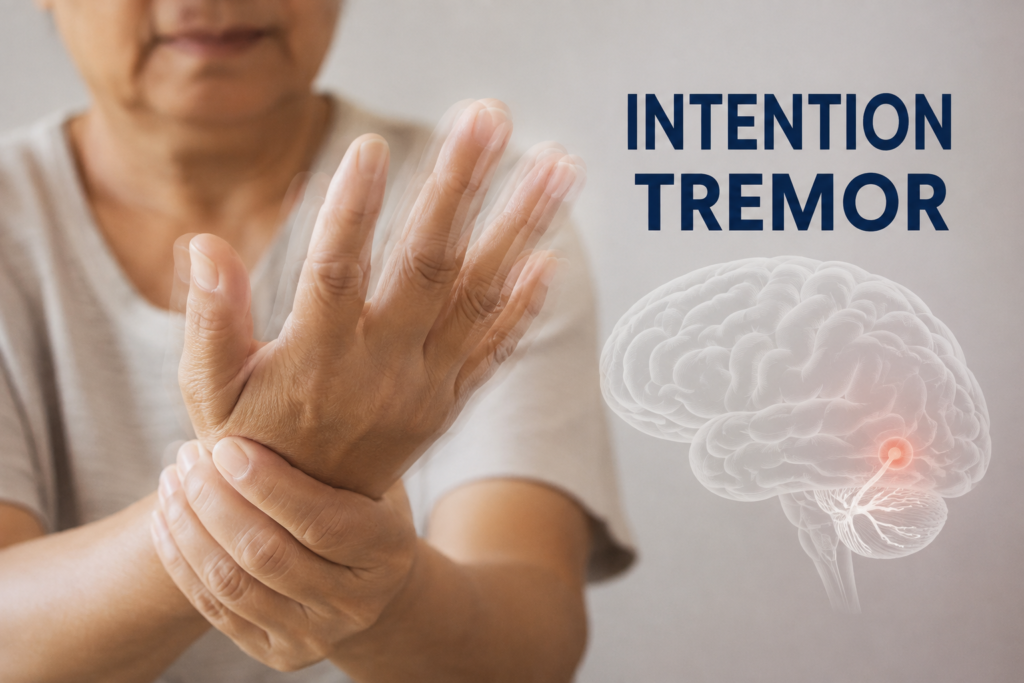
Intention Tremor
NittyBrain Health · Neurology
When Your Hands Won’t Listen: Living With Intention Tremor
The closer you reach for the cup, the worse the shaking gets. Here’s what’s actually happening in your brain — and what you can do about it.
There’s a specific kind of frustration that comes from watching your own hand fail you. You reach for your coffee mug, steady at first, and then — right as your fingers close in — it starts to zigzag. The tremor gets worse, not better, the nearer you get to what you’re trying to touch. If that sounds familiar, you’re not clumsy, and you’re not imagining it. You’re likely describing an intention tremor, one of the more distinctive and least understood movement symptoms in neurology.
This guide walks through what an intention tremor actually is, why it behaves so differently from a typical shaky hand, what conditions cause it, how doctors diagnose it, and — most importantly — what genuinely helps. It’s written for the person living with it, not just the textbook describing it.
What Exactly Is an Intention Tremor?
An intention tremor is an involuntary, rhythmic shaking that shows up during a deliberate, goal-directed movement — reaching for a doorknob, guiding a spoon to your mouth, or touching your finger to your nose. It’s not present at rest. It builds as the limb approaches its target, a pattern neurologists call terminal dysmetria: you overshoot or undershoot the thing you’re aiming for, and the shaking peaks right at the moment of contact.
This isn’t random misfiring. Intention tremor is a coordination problem rooted in the cerebellum — the structure tucked beneath your brain’s main hemispheres that fine-tunes movement in real time. Think of the cerebellum as a movement’s autocorrect system, constantly comparing where a limb is going against where it’s supposed to go and making micro-adjustments along the way. When that feedback loop is damaged, those corrections come in too late, too strong, or in the wrong direction — and the result is a limb that overshoots, wobbles, and zigzags as it nears its target. That’s why the tremor is worst exactly when precision matters most.
Because of this cerebellar origin, clinicians also refer to it as a cerebellar tremor. It’s typically slow — below 5 Hz — and high in amplitude, meaning the movement is broad and visible rather than a fine, subtle shake.
Quick way to picture it: Imagine trying to thread a needle while someone gently jostles your elbow — except the jostling only starts once the thread is an inch from the eye. That’s the finger-to-nose test doctors use, and it’s the clearest window into how intention tremor behaves.
What It Actually Feels Like Day to Day
Textbook descriptions rarely capture the lived reality. People with intention tremor often describe:
- Drinks spilling in the last few inches before the cup reaches their lips
- Handwriting that starts clean and dissolves into jagged strokes as they finish a letter
- Trouble buttoning shirts or threading a belt, where the final pinch is the hardest part
- A voice that wavers on longer or more deliberate sentences, if the tremor involves speech muscles
- Fatigue from the sheer physical effort of “fighting” the shake through a task
Intention tremor frequently travels with other cerebellar signs — unsteady, wide-based walking (ataxia), rapid uncontrolled eye movements (nystagmus), or trouble rapidly alternating movements like turning a doorknob back and forth (dysdiadochokinesia). If you’re noticing several of these together, that combination is meaningful information for a doctor, not just a list of separate annoyances.
What Causes Intention Tremor?
Because intention tremor is a symptom of cerebellar dysfunction rather than a disease on its own, the underlying cause varies widely from person to person. The most frequently identified causes include:
- Multiple sclerosis (MS): The single most common cause. MS attacks the protective myelin sheath around nerves, and lesions in the cerebellum or its connecting pathways frequently produce intention tremor — sometimes as one of the earliest noticeable signs of the disease.
- Stroke: A stroke affecting the cerebellum or brainstem can abruptly damage the circuits responsible for coordinated, visually guided movement.
- Traumatic brain injury: Direct trauma to the cerebellum or the pathways feeding into it can produce a persistent tremor.
- Brain tumors: Growths that press on or infiltrate the cerebellum can disrupt its function.
- Degenerative conditions: Spinocerebellar ataxia and related hereditary disorders progressively damage cerebellar tissue.
- Toxic exposure: Heavy metal exposure (including mercury), certain solvents, and chronic alcohol use can injure the cerebellum over time.
- Medications: Some anti-seizure drugs and other medications list tremor as a side effect, and stopping or switching the medication may resolve it.
- Metabolic and hereditary conditions: Rare causes include Wilson’s disease, a hereditary disorder affecting copper metabolism.
Intention Tremor vs. Essential Tremor vs. Resting Tremor
One of the most common points of confusion is telling intention tremor apart from other shaking conditions. Here’s the distinction that actually matters clinically:
| Type | When It Shows Up | Typical Cause |
|---|---|---|
| Intention tremor | Worsens near the end of a goal-directed movement | Cerebellar dysfunction (MS, stroke, injury) |
| Essential tremor | Holding a posture, like arms outstretched | Often hereditary; not cerebellar damage |
| Resting tremor | Present when the limb is fully relaxed and still | Classically Parkinson’s disease |
This distinction isn’t academic — it directly shapes which tests a doctor orders and which treatments are worth trying first.
How Doctors Diagnose It
Diagnosis usually starts with a hands-on neurological exam. The classic tool is the finger-to-nose test: you touch your finger to your nose, then to the examiner’s finger, repeatedly, while they watch how the tremor changes as your finger closes in on each target. A related test, the heel-to-shin test, checks for the same pattern in the legs.
From there, a neurologist typically looks for the underlying cause through:
- MRI of the brain: To check for cerebellar lesions, stroke damage, tumors, or the demyelinating patches characteristic of MS
- Blood work: To screen for toxic exposures, vitamin deficiencies, or metabolic causes like Wilson’s disease
- Medication review: To rule out a drug-induced tremor before pursuing more invasive testing
- Additional neurological testing: Assessing gait, eye movements, and reflexes to build a full picture of cerebellar function
What Actually Helps
Here’s the honest part most quick-answer sites skip: intention tremor is genuinely harder to treat than essential tremor. The medications that work well for essential tremor — beta-blockers like propranolol, anticonvulsants like primidone — tend to be less reliable here, because the problem sits in cerebellar circuitry that doesn’t respond to those drugs the same way. That doesn’t mean nothing works; it means treatment is more individualized and often layered.
A realistic treatment plan usually combines several of the following:
- Treating the root cause: If MS is driving the tremor, disease-modifying MS therapy is the priority. If a medication is the culprit, switching or stopping it can resolve the tremor entirely.
- Physical therapy: Targeted exercises can improve limb stability, strength, and gait, and help the body compensate for lost fine-motor precision.
- Occupational therapy: Practical strategies for daily tasks — wrist or ankle weights to dampen the swing of a tremor, adaptive utensils, and techniques for gross-motor substitutes for fine-motor tasks.
- Medication trials: Some clinicians still trial beta-blockers, anticonvulsants, or benzodiazepines on a case-by-case basis, since individual response varies even when population-level evidence is mixed.
- Deep brain stimulation (DBS): For severe, disabling tremor that hasn’t responded to other treatments, DBS — a surgically implanted device that regulates abnormal brain activity — is an option worth discussing with a movement disorder specialist.
- Assistive strategies: Using the unaffected limb to stabilize the affected one, favoring gross movements over fine ones, and building tasks around the tremor rather than against it.
The throughline across all of these: effective management starts with identifying why the intention tremor is happening. A treatment plan built around the actual cause will always outperform a generic one aimed at the shaking alone.
Living With It, Not Just Managing It
There’s a psychological weight to a tremor that gets worse the moment precision matters most — it can make ordinary tasks feel like a performance under pressure. Occupational therapists often note that reducing that pressure, rather than fighting the tremor head-on, tends to help: heavier utensils, wider grips, larger buttons, voice-to-text tools for writing. Small environmental changes can restore independence faster than any single medication.
If the tremor is tied to a progressive condition like MS, connecting with a movement disorder specialist or an MS-focused rehabilitation team — rather than managing it through a general practitioner alone — tends to lead to more tailored, effective care.
When to See a Doctor
Get evaluated promptly if a tremor appears suddenly, worsens over days or weeks, interferes with eating, dressing, or writing, or shows up alongside slurred speech, vision changes, numbness, or balance problems. A neurologist can determine whether what you’re experiencing is truly an intention tremor and start tracking down the cause.
Frequently Asked Questions
What is an intention tremor a sign of?
Most often, cerebellar dysfunction linked to multiple sclerosis, stroke, or brain injury — though a full neurological workup is needed to pin down the specific cause.
How is intention tremor different from essential tremor?
Essential tremor shows up when holding a position and usually responds well to beta-blockers. Intention tremor worsens as you approach a target and generally responds less predictably to the same medications.
Can intention tremor be cured?
There’s usually no standalone cure, since it’s a symptom of underlying cerebellar damage. Treating the root cause, combined with therapy and, in severe cases, deep brain stimulation, can significantly reduce its impact.
When should I see a doctor about a tremor?
If it appears suddenly, worsens quickly, disrupts daily tasks, or comes with other neurological symptoms — see a neurologist rather than waiting it out.
A note on this article: This content is for general information only and isn’t a substitute for a diagnosis or treatment plan from a licensed neurologist. If you’re experiencing a tremor, please talk to a healthcare provider about your specific situation.
Researched and written by the NittyBrain editorial team. NittyBrain is committed to publishing original, thoroughly researched health and finance content that helps readers understand what’s happening in their bodies and their finances — free from copy-paste medical filler.