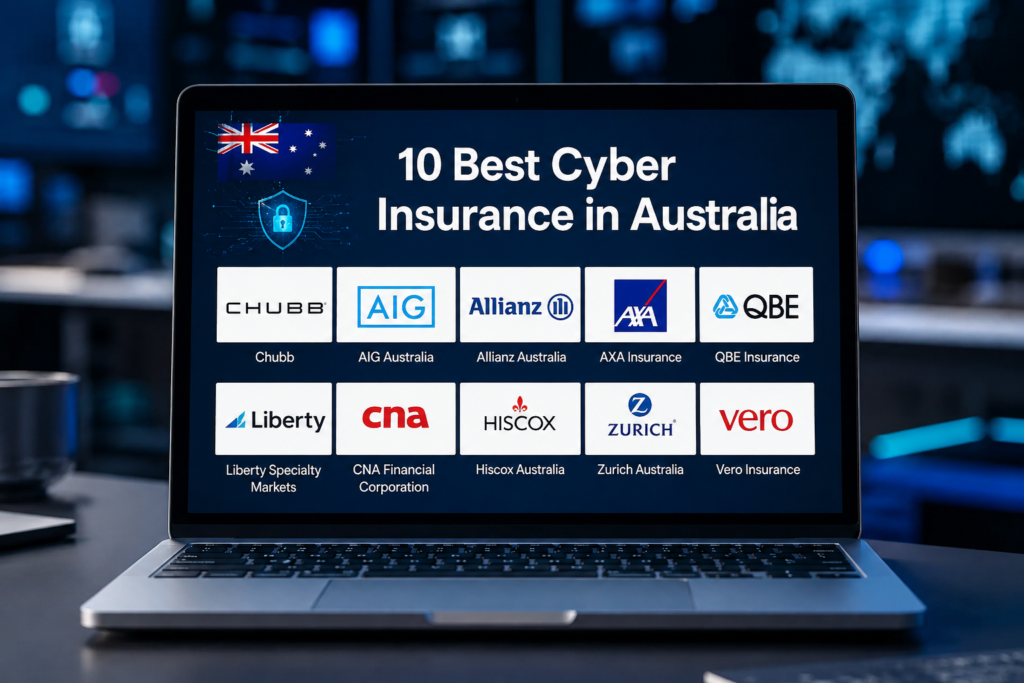
10 Best Cyber Insurance in Australia
10 Best Cyber Insurance Companies in Australia (2026): What Actually Protects You When the Worst Email Lands
Somewhere in Australia, right now, a business owner is staring at a ransom note on their screen instead of their invoicing software. It happens roughly once every six minutes, according to the Australian Signals Directorate’s Cyber Security Centre — and most of the people it happens to never thought it would be them. That’s the uncomfortable truth about cyber insurance: nobody buys it because they expect to need it. They buy it, if they’re smart, before they find out the hard way.
We spent weeks pulling apart policy wordings, incident response track records, broker feedback, and the fine print that most comparison sites skip straight past, so you don’t have to. Below is our independently researched ranking of the best cyber insurance providers in Australia for 2026 — for small businesses, mid-market companies, and individuals who want their digital life covered too.
Quick Answer
- Best overall in Australia: Emergence Insurance — in-house 24/7 incident response, no outsourced claims handling
- Best for large enterprises: Chubb — global backing, 54-country breach response network
- Best for mid-market & corporates: DUAL Australia — flexible underwriting across 21 product lines
- Best for tech-forward SMEs: CFC Underwriting — cyber-native policy design
- Best bundled with general business cover: CGU — one policy, one renewal date
- Best for personal cyber cover: Chubb Masterpiece — folds into home and contents insurance
Figures drawn from the ASD’s Australian Cyber Security Centre Annual Cyber Threat Report and 2026 industry underwriting data.
Why Cyber Insurance Has Stopped Being Optional in Australia
Three incidents changed how Australian insurers, and Australian business owners, think about cyber risk. The Medibank breach ran up costs north of $126 million. The MediSecure incident exposed roughly 12.9 million patient records. And in 2025, a wave of attacks against superannuation funds hit hundreds of thousands of member accounts. None of those organisations were careless by industry standards — they were simply targets, the same way any business holding customer data, payment details, or staff records is a target.
Add the legal layer on top: the Notifiable Data Breaches scheme requires businesses to report to the OAIC and to every affected individual when a breach is likely to cause serious harm. That’s not a cost you can absorb quietly. It’s a cost with a paper trail, a timeline, and often a lawyer attached to it — which is exactly the gap cyber insurance australia policies are built to fill.
How We Ranked These Cyber Insurance Companies
Every insurer on this list was assessed against the same criteria, not just marketing copy:
- In-house vs. outsourced incident response, and how fast it activates
- Breadth of first-party cover (business interruption, data recovery, cyber extortion) and third-party liability
- Broker and claims-handler feedback from Australian industry publications
- Financial strength and claims-paying track record of the underwriter
- Fit for specific business sizes — sole trader through to ASX-listed corporate
- Transparency around sub-limits and exclusions, which is where most disputes start
The 10 Best Cyber Insurance Companies in Australia
Emergence Insurance — Best Overall
Best claims handlingSME & mid-market
Emergence built its entire model around keeping incident response in-house rather than outsourcing to a panel of third parties. That matters more than it sounds: when every minute of a ransomware event counts, you don’t want your insurer relaying instructions through two extra companies. Its flagship Cyber Event Protection policy (updated to CEP-005.1 in 2026) was refreshed based on direct broker feedback, expanding cover for non-IT business interruption and financial loss.
Standout: 24/7 incident response that regularly activates within 30 minutes of a reported breach, run by Emergence’s own specialist claims team rather than a subcontracted call centre.
Chubb — Best for Established & Growing Businesses
Global backingPersonal + business
Chubb is one of the few insurers on this list offering both serious commercial cyber towers and a genuinely useful personal cyber add-on through its Masterpiece home and contents policy. On the business side, its 2025–26 “Elite II” wording folds property, liability, and cyber into a single schedule for technology, professional services, and life sciences businesses — useful if you’re tired of juggling three renewal dates.
Standout: Operates breach response infrastructure across 54 countries, which matters if your business trades internationally or stores data offshore.
DUAL Australia — Best for Mid-Market & Corporates
Flexible underwriting21 product lines
DUAL operates as an underwriting agency rather than a direct insurer, which gives it more flexibility to structure cyber cover around unusual risk profiles — think professional services firms with cross-border clients, or businesses that don’t fit a neat off-the-shelf template. It sits inside a broader financial-lines offering, so brokers can bundle cyber with management liability without starting from scratch.
Standout: Genuine underwriting flexibility for mid-market and corporate risks that standard retail policies often decline or heavily sub-limit.
CFC Underwriting — Best Tech-Native Policy Design
Built for cyber first
Unlike insurers that added cyber cover onto an existing property or liability book, CFC built its policy language around digital risk from the start. That shows in how it handles emerging exposures — social engineering fraud, cloud service outages, and supply-chain attacks are treated as first-class risks rather than awkward add-ons.
Standout: Policy wording that keeps pace with how attacks actually happen in 2026, rather than reading like a retrofitted property form.
CGU — Best for Bundling with Business Insurance
One policy, one renewalSME-friendly
If you’re a small business owner who’d rather not manage four separate insurance relationships, CGU’s strength is breadth. It’s a market-leading intermediated Australian insurer with the infrastructure to fold cyber into a broader business insurance package, backed by technical underwriting support most direct-to-consumer platforms can’t match.
Standout: Simplicity — one insurer, one renewal date, one point of contact for both your general business risks and your cyber exposure.
Vero — Best for Broker-Tailored Cover
Broker-led
Vero leans heavily on its broker network to tailor cyber policies to individual business risk profiles rather than pushing a one-size-fits-all product. For business owners who want a human talking them through the exclusions before they sign, that relationship-first approach is worth the extra conversation.
Standout: Genuine policy customisation through experienced commercial brokers, rather than a locked-down online quote tool.
QBE — Best for Large Enterprises
Enterprise scale
QBE’s cyber offering is built for organisations with genuinely complex risk — multiple entities, large customer databases, or regulatory exposure across several jurisdictions. It’s less about being the cheapest option and more about having the balance sheet and claims infrastructure to absorb a large-scale event.
Standout: Capacity to underwrite high-limit towers for enterprise clients that smaller underwriters simply can’t take on.
Allianz — Best for Multinational Exposure
Global claims network
Allianz’s cyber cover is a natural fit for Australian businesses with operations, suppliers, or customers offshore. Its global claims network means a breach affecting your Singapore office and your Sydney head office can, in theory, be handled under one coordinated response rather than two disconnected local claims.
Standout: Coordinated multinational claims handling, which very few Australian-only underwriters can offer.
AIG — Best for High-Limit Corporate Towers
High limits
AIG typically appears where a single insurer can’t or won’t take on the full limit a large organisation needs, sitting as part of a layered “cyber tower” alongside other underwriters. That’s a specialist corner of the market, but an important one for ASX-listed companies and large private businesses.
Standout: Willingness to participate in layered, high-limit programs for the largest Australian risks.
Zurich — Best for Consistent Global Claims Experience
Established global insurer
Zurich rounds out this list as a dependable option for businesses that value a long-established global insurer with consistent claims processes over a specialist boutique underwriter. It won’t necessarily be the cheapest quote you get, but it’s rarely the riskiest choice either.
Standout: Long-standing global claims consistency, useful if predictability matters more to you than niche policy features.
Quick Comparison Table
| Insurer | Best For | Standout Strength | Watch For |
|---|---|---|---|
| Emergence | SMEs & mid-market | In-house 24/7 response | Not built for large corporates |
| Chubb | Growing businesses + personal cover | 54-country breach network | Higher premiums |
| DUAL Australia | Mid-market & corporates | Flexible underwriting | Broker-access only |
| CFC Underwriting | Tech-forward SMEs | Cyber-native wording | Digital-first, fewer touchpoints |
| CGU | Bundled business cover | One policy, one renewal | Lower bundled sub-limits |
| Vero | Tailored broker cover | Custom policy design | No instant online quotes |
| QBE | Large enterprises | High-limit capacity | Overkill for small business |
| Allianz | Multinational businesses | Coordinated global claims | Best value at scale |
| AIG | High-limit corporate towers | Layered program capacity | Not standalone-SME friendly |
| Zurich | Predictable global claims | Long-standing consistency | Less cyber-specialist wording |
What Does Cyber Insurance in Australia Actually Cover?
Most Australian cyber policies split cover into two buckets. First-party cover pays for your own losses: incident response and forensic investigation, data recovery, business interruption while systems are down, and the cost of notifying affected customers under the Notifiable Data Breaches scheme. Third-party cover handles liability to others — regulatory investigations, privacy claims, and legal defence costs if a customer or partner sues over a breach that started on your systems.
What Cyber Insurance Won’t Cover
This is where most disputes happen, so read your schedule carefully. Standard exclusions across the Australian market typically include pre-existing breaches you hadn’t yet discovered, intentional acts by directors or officers, war and terrorism where excluded, and — critically — claims where your application misrepresented your actual security controls. If you told your insurer you had multi-factor authentication everywhere and you didn’t, that gap can void the very cover you’re relying on.
How Much Does Cyber Insurance Cost in Australia in 2026?
For Australian SMEs, typical 2026 policy aggregates run from roughly $500,000 to $5 million, with annual premiums generally landing somewhere between $3,000 and the low five figures depending on industry, revenue, and how mature your security controls already are. Businesses handling large volumes of customer data, or operating in regulated sectors like health and finance, sit at the higher end of that range.
Insurers increasingly price your premium — and decide whether to offer cover at all — based on how closely your security posture maps to the ASD’s Essential Eight: multi-factor authentication on every account, tested and immutable backups, a real patching programme, endpoint detection and response, email authentication, and documented staff training. Tighten those before you go to market, and you’ll see it reflected in your quote.
How to Choose the Right Cyber Insurance Policy
- Match the insurer to your business size — don’t pay enterprise pricing for a five-person team, and don’t undershoot your limits if you handle sensitive customer data
- Ask specifically how incident response is triggered and how fast it activates — in-house teams like Emergence’s tend to move faster than outsourced panels
- Get the ransomware sub-limit in writing — it’s often lower than your overall policy aggregate
- Confirm what security controls you’re being asked to attest to, and make sure they’re actually in place before you sign
- If you trade internationally, check whether claims are coordinated globally or handled as separate local claims
Related Reading on NittyBrain
Comparing cyber insurance globally, or weighing up other types of cover? See our breakdown of the top cyber insurance companies worldwide, or if you’re assessing broader business protection, our guide to short-term vs. long-term disability insurance covers a different but equally important risk gap for business owners.
Frequently Asked Questions
What is the best cyber insurance company in Australia?
Emergence Insurance ranks best overall for Australian SMEs and mid-market businesses because of its in-house 24/7 incident response and consistently strong broker feedback. Larger corporates with international exposure are often better served by Chubb, QBE, or Allianz.
Is cyber insurance a legal requirement in Australia?
No, cyber insurance is not legally mandatory for Australian businesses. However, obligations under the Notifiable Data Breaches scheme and the Privacy Act create real financial exposure after a breach, which is why insurers and regulators increasingly treat it as a practical necessity rather than an optional extra.
How much does cyber insurance cost for a small business in Australia?
Most Australian SMEs pay somewhere between $3,000 and low five-figure annual premiums for policy aggregates of $500,000 to $5 million, depending on industry, data volume, and existing security controls such as MFA and immutable backups.
Does home and contents insurance cover cyber attacks in Australia?
Standard home and contents policies generally do not cover cyber incidents. Chubb is one of the few insurers offering personal cyber cover as an add-on to its Masterpiece home and contents policy, covering things like cyber extortion and unauthorised account transfers.
What’s the difference between first-party and third-party cyber cover?
First-party cover pays for your own losses — incident response, data recovery, and business interruption. Third-party cover pays for liability to others, including legal costs and regulatory investigations that follow a breach affecting customers or partners.
Will insurers deny a cyber claim if I don’t have MFA enabled?
Potentially, yes. If your application stated you had security controls such as multi-factor authentication in place and an investigation finds you didn’t, insurers can treat that as a misrepresentation and use it to deny or reduce a claim. Confirm your actual controls before signing, not after.